The CAP Theorem Explained: Everything You Need to Know
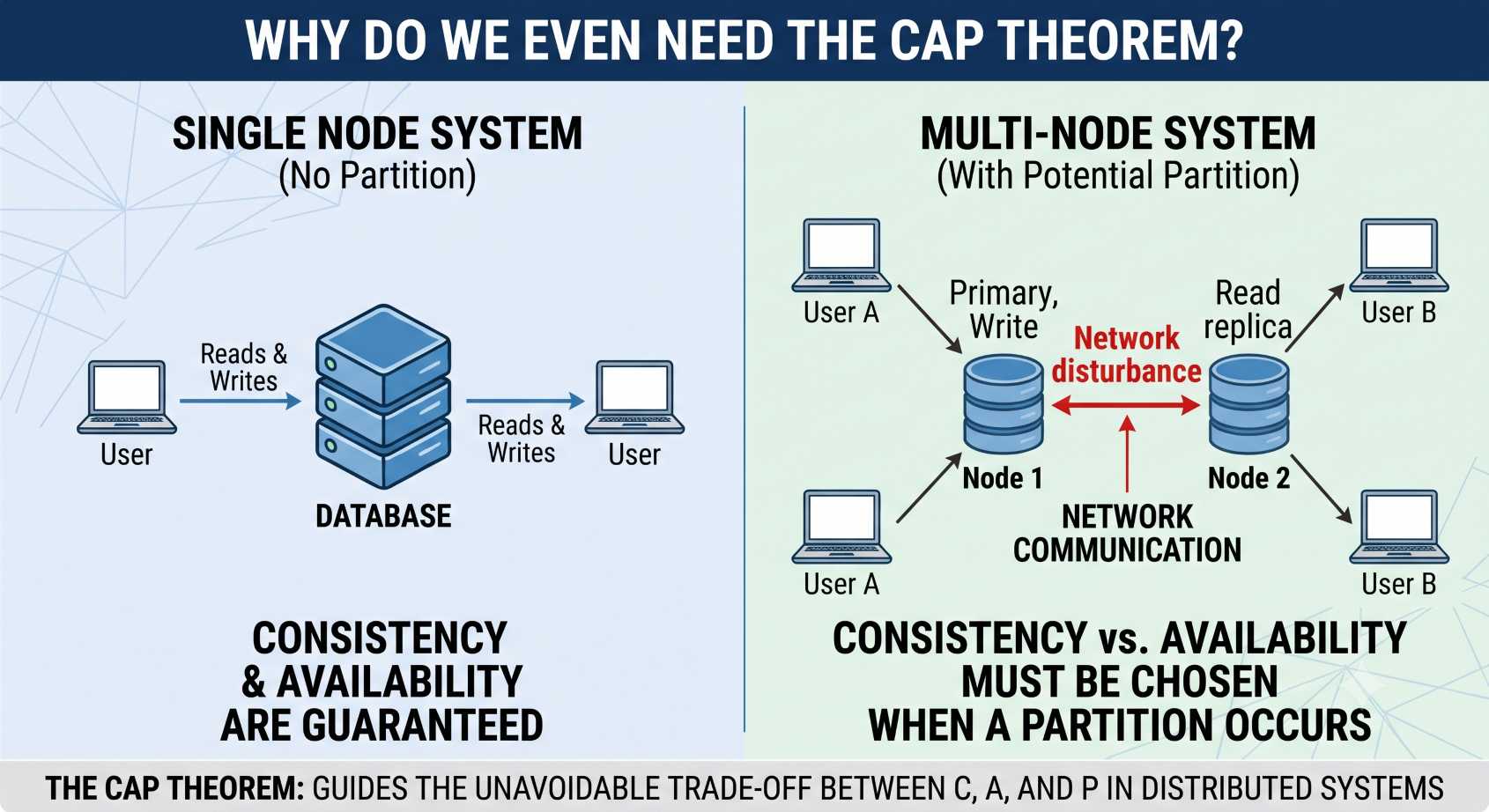
CAP Theorem (Applies Only to Distributed Database Systems)
Note:
- CAP theorem only and only exists because of distributed database systems
- it will not exist/needed if the database is centralized
- it has nothing to do with monolity/distributed codebase
The CAP theorem describes the trade-offs in how a distributed data store is architected. It applies strictly to databases that span multiple nodes- regardless of how the application tier above it is structured (whether it's a monolith, microservices, or a distributed system of services).
Important
- get basis understanding of distributed database.
The Three Properties
- Consistency: Ensures every read receives the most recent data, or an error.
- Availability: Ensures every read request receives a response, without any guarantee that it is the most recent data.
- Partition Tolerance (specific to network disruption between database nodes): Ensures the system continues to operate even if network communication between nodes is disrupted.
It says that a distributed data store can guarantee at most two of the three properties: consistency, availability, and partition tolerance.
Note
- Partition tolerance is not optional so the choice is between Availability and Consistency
Why Partition Tolerance Is Not Optional
In a distributed system you have multiple database nodes communicating over a network. That network can break - packets drop, links fail, regions isolate. Building for partition tolerance (P) is therefore not optional; you design assuming partitions will happen.
Approaches to implementing Partition Tolerance
Partition tolerance means the cluster keeps making progress (or at least fails in a controlled way) when some nodes cannot talk to others. Common building blocks:
1 Replication
- Keep copies of data on multiple nodes so a subset of the cluster can still serve reads (and sometimes writes) during a split.
- Synchronous vs asynchronous replication changes how “fresh” those copies are when a partition starts.
2 Quorum / majority consensus
- Require a majority (or a configured quorum) of nodes to acknowledge a write or answer a read.
- During a partition, only the side that still holds a quorum can accept writes - the minority side may reject or go read-only. This is how many CP systems stay consistent under split-brain.
3 Consensus protocols (Raft, Paxos, and similar)
- Elect a leader and replicate a log so nodes agree on the order of operations.
- When the network splits, the minority cannot elect or keep a valid leader, so they stop accepting conflicting writes.
4 Conflict detection and resolution (typical of AP designs)
- Allow both sides of a partition to accept writes, then reconcile later with version vectors, last-write-wins, CRDTs, or application-level merge rules.
- Clients stay available; consistency is recovered after the partition heals.
5 Health checks, fencing, and timeouts
- Detect unreachable peers, fence stale leaders, and fail over so a partitioned node cannot keep writing as if it were still authoritative.
6 Topology awareness
- Place replicas across availability zones / regions and define which failure domains you tolerate, so a single network cut does not isolate all copies of critical data.
The Real Trade-off: CP vs AP
Once you assume a network disruption will happen, you must choose:
- Available for all read/write (favor Availability), or
- Wait for connection restoration and prevent partial / conflicting read-write (favor Consistency)
That is the practical CAP choice in distributed databases: CP vs AP (with P already required).
| Choice | Behavior during a partition | Typical fit |
|---|---|---|
| CP | May refuse or error on some requests until the cluster can agree on the latest state | Money, inventory, bookings |
| AP | Keeps responding; data may be stale or diverge until sync | Feeds, likes, soft state |
Important Note: CAP Is About the Database Layer
If something goes wrong with data at the server / application service layer - for example a distributed services network issue between microservices - that is not covered by CAP.
CAP only applies to the database (distributed data store) layer. Application-level failures, service mesh outages, and API gateway problems are separate concerns.
Examples
Banking application → Consistency over Availability
Prefer CP: better to return an error or delay a transfer than to allow partial or false balances when nodes cannot agree. Preventing incorrect debit/credit during a partition matters more than answering every request immediately.
Social media feed → Availability over Consistency
Prefer AP: an outdated like count or a comment that appears a few seconds late after sync is usually acceptable. Keeping the feed readable and writable during a partition is more important than perfect real-time consistency.
Takeaways
- CAP is a distributed database theorem - not a general microservices theorem.
- In real distributed stores, partition tolerance is assumed; the design choice is mainly C vs A when the network splits.
- Pick CP when wrong data is worse than downtime; pick AP when stale or eventually consistent data is acceptable.